
WXYZ: Deceased. TV news reporter.

- Always the Hardworking Crew at WXYZ
And, yes, having fun at the same time.
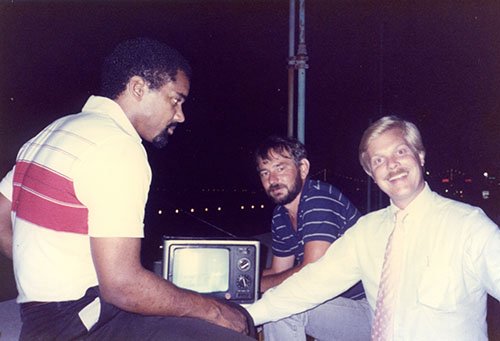
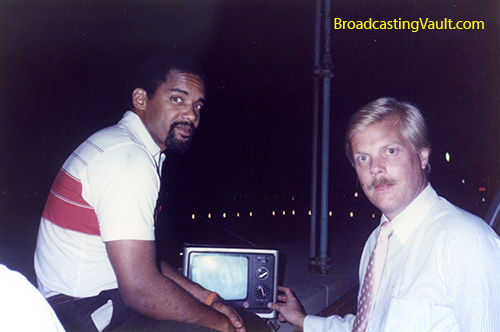
Herman McAlpain Hector Heath Dave Gilbert - Passing Time While on Remote
- WXYZ “Makes” News
TV Crew Gets News First Hand
Todd Seibt writes,
A Detroit-area television crew made news in Flint Thursday night when their equipment truck was stolen 10 minutes before they went live for an 11 p.m. newscast.
Reporter Dave Gilbert and cameraman-engineer Kevin Hawley were discussing final shots for a satellite broadcast to their station. Channel 7 in Southfield, when a drunken man jumped into the station’s Chevrolet Suburban and drove away, they said.
The broadcasters were in Flint to cover General Motors announcements of layoffs and plant closings.
The fleeing Suburban, painted with the Channel 7 logo, dragged camera and sound cables nearly a block before snapping them off, Hawley said.
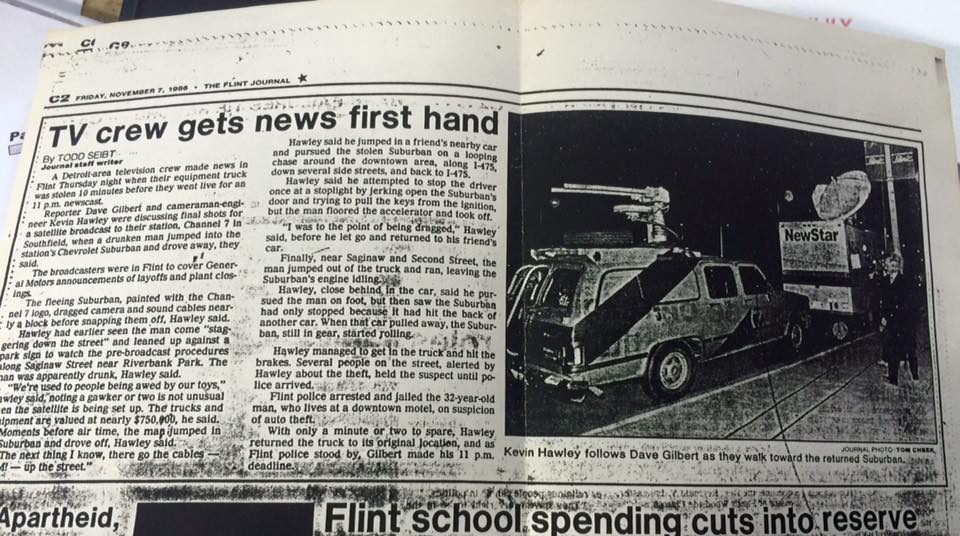
WXYZ Makes News The Flint Journal November 7 1986 Hawley had earlier seen the man come “staggering down the street” and leaned up against a park sign to watch the pre-broadcast procedures along Saginaw Street near Riverbank Park. The man was apparently drunk, Hawley said.
“We’re used to people being awed by our toys,” Hawley said, “nothing a gawker or two is not unusual when the satellite is being set up. The trucks and equipment are valued at nearly $750,000, he said.
Moments before air time, the man jumped in the Suburban and drop off, Hawley said.
The next thing I know, there go the cables – DAM! – up the street.”
Hawley said he jumped in a friend’s nearby car and pursued the stolen Suburban on a looping chase around the downtown area, along I-475, down several side streets, and back to I-475.
Hawley said he attempted to stop the driver once at a stoplight by jerking open the Suburban’s door and trying to pull the keys from the ignition, but the man floored the accelerator and took off.
I was to the point of being dragged,” Hawley said, before he let go and returned to his friend’s car.
Finally, near Saginaw and Second Street, the man jumped out of the truck and ran, leaving the Suburban’s engine idling.
Hawley, close behind in the car, said he pursued the man on foot, but then saw the Suburban had only stopped because it had hit the back of another car. When that car pulled away, the Suburban, still in gear, started rolling.
Hawley managed to get in the truck and hit the brakes. Several people on the street, alerted by Hawley about the theft, held the suspect until police arrive.
Flint police arrested and jailed the 32-year-old man, who lives at a downtown motel, on suspicion of auto theft.
With only a minute or two to spare, Hawley returned the truck to its original location, and as Flint police stood by, Gilbert made his 11 p.m. deadline. [1]
References:

Leave a Reply